The complete MUN guide
Everything you need for your first conference and beyond: how MUN works, the people and committees you'll meet, how to prepare, how to write resolutions, and every rule of procedure. This guide follows THIMUN-style rules.
What is Model UN?
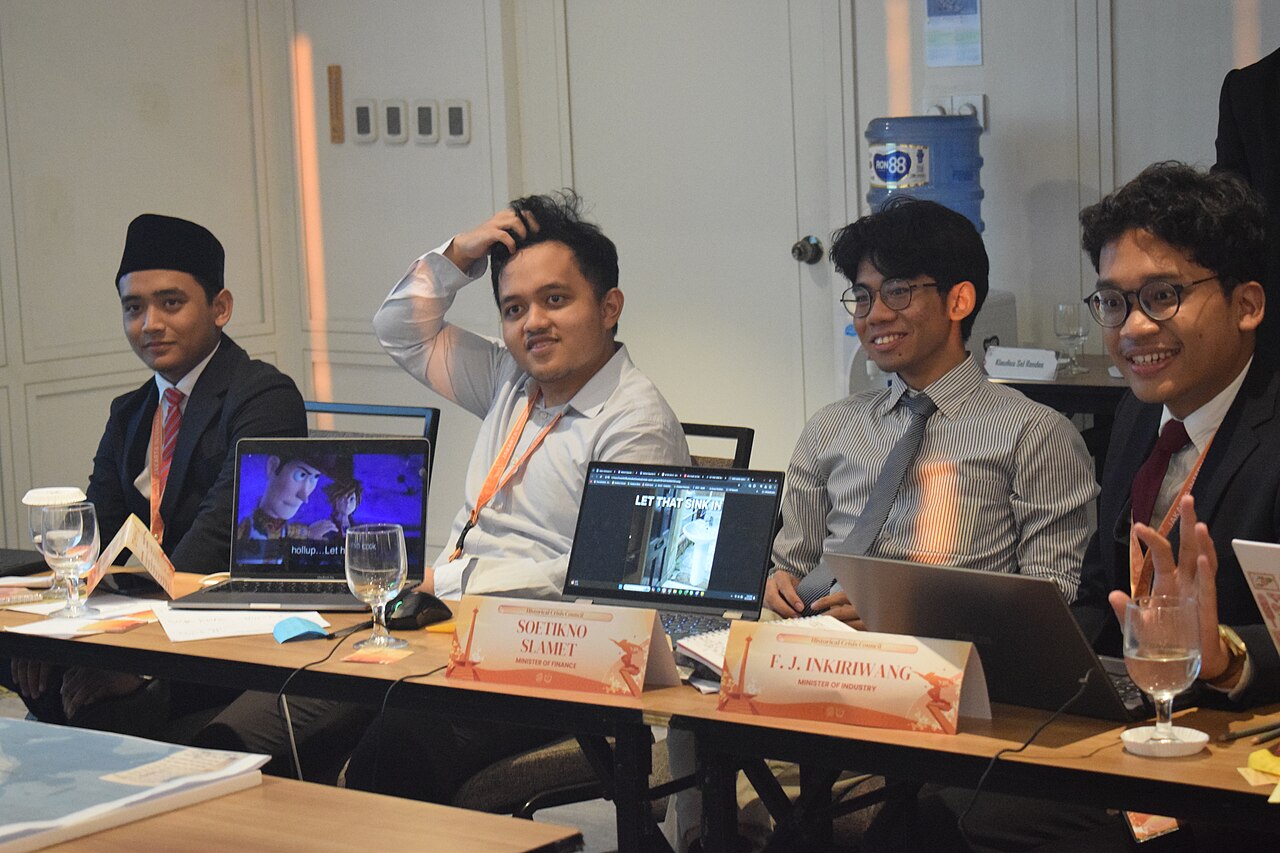
Model United Nations (MUN) is a simulation of the United Nations. Each student becomes a delegate representing a country, not their own opinions. Delegates research global issues, negotiate with other countries, write resolutions (formal proposals for action), debate them and vote.
MUN builds research, writing, public speaking, negotiation and teamwork skills, and teaches you how international diplomacy works.
What is THIMUN?
THIMUN stands for The Hague International Model United Nations. It is a large annual conference in The Hague, Netherlands, run by the THIMUN Foundation, and its rules are used by many affiliated and THIMUN-style conferences around the world (for example THIMUN Singapore).
The THIMUN style centres on resolutions. Delegates usually arrive with draft clauses, combine them with allies during lobbying and merging, and then spend formal debate discussing, amending and voting on those resolutions one at a time.
Who's who at a conference
| Role | What they do |
|---|---|
| Delegate | Represents one country (or organisation) in one committee. Researches, lobbies, writes clauses, speaks and votes. |
| Delegation / Ambassador | A school often represents one country across several committees. The group is the delegation; many conferences name one member the ambassador or head delegate. |
| Student Officers | The students who run each committee: usually a President or Chair and one or more Deputy Chairs. They recognise speakers, set debate time, rule on points and motions, and run voting. |
| Secretariat | The student leadership of the whole conference, led by the Secretary-General. |
| Admin staff | Students who help run committees, for example by carrying notes between delegates. |
| Approval Panel | Checks draft resolutions for format and language before they can be debated. |
| MUN Director | The teacher who leads a school's delegation. |
Committees
Each committee (also called a forum) discusses its own issues. Which committees exist changes from conference to conference and year to year. These are the most common:
General Assembly (GA) committees
Every UN member state has a seat in the General Assembly. In MUN, its main committees are often run separately:
| Committee | Focus |
|---|---|
| GA1: Disarmament & International Security | Weapons, arms control, threats to peace |
| GA2: Economic & Financial | Development, trade, finance, poverty |
| GA3: Social, Humanitarian & Cultural | Human rights, refugees, social issues |
| GA4: Special Political & Decolonisation | Peacekeeping, decolonisation, space, other political issues |
| GA6: Legal | International law |
Other common committees
- Economic and Social Council (ECOSOC): economic, social and environmental issues; the real ECOSOC has 54 member countries.
- Human Rights Council / Commission: human rights situations and protections.
- Environment Commission: climate change, biodiversity and the environment.
- Special Conference: a one-off committee on a theme that changes each year.
- Security Council (SC): 15 members, including 5 permanent members (China, France, Russia, the United Kingdom and the United States) that hold a veto. Its decisions can be binding. See Security Council rules.
- Historical Security Council: the Security Council set in a past year, debating a historical crisis.
- International Court of Justice (ICJ): students act as judges and advocates and argue a legal case instead of writing resolutions.
- Advisory Panel: a smaller expert-style committee that some conferences run on a specific question.
How a THIMUN conference runs
The exact schedule varies, but most THIMUN-style conferences follow this order:
- Preparation. You research your country and issues, write a policy statement and draft clauses. Preparation guide →
- Opening ceremony. Welcome speeches and the official start of the conference.
- Lobbying and merging. Informal time: delegates find allies, combine their clauses into one draft resolution, and choose a main submitter and co-submitters. More →
- Approval panel. Drafts are checked for format and language. More →
- Opening speeches. Selected delegations give a short speech (often about one minute) on their country's position.
- Debate on resolutions. Each resolution is introduced, debated, amended and voted on. Rules of procedure →
- Closing ceremony. The end of the conference.
Using this guide
Preparation
Research, policy statements, opening speeches, dress code and conduct.
Read →Resolutions
Lobbying, merging, the approval panel, resolution format and phrase lists.
Read →Rules of Procedure
Points, motions, yielding, amendments, voting and the Security Council.
Read →Glossary & Phrases
Every term and phrase, plus answers to first-timer questions.
Read →