The World Scholar's Cup
An international academic competition for teams of three, built around a new theme every year. This guide covers the subjects, the rounds, all four events and how to prepare.
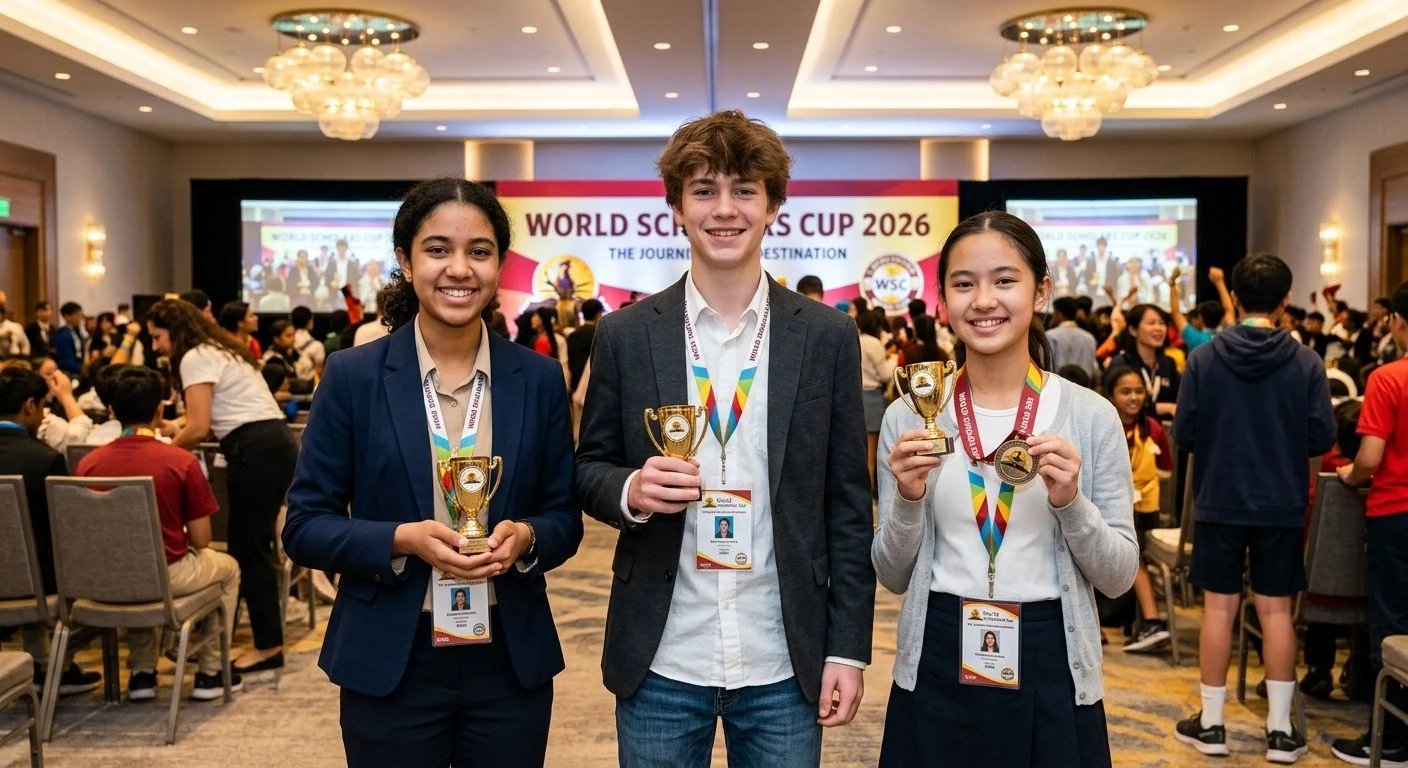
Overview
WSC is less about memorising facts and more about connecting ideas across subjects, arguing, writing and working as a team. Each regional round has four main events:
Team Debate
Three-on-three debates on motions from across the curriculum.
Collaborative Writing
Argumentative writing, planned and improved as a team.
Scholar's Challenge
An individual multiple-choice test on the curriculum.
Scholar's Bowl
A live team quiz answered with clickers.
Some tournaments also hold non-competitive social events.
Teams and divisions
- Teams have three students. Two-member teams can compete but, according to WSC, are very unlikely to win team awards in three of the four events.
- Students compete in age-based divisions, usually Junior and Senior. The age cutoff is set each season, so check the official website.
Theme and subjects
Every year has a new overall theme, and the curriculum explores it through six subject areas:
- Science & Technology
- Art & Music
- Social Studies
- Literature & Media
- History
- Special Area (changes each year)
The subject list can change between seasons, so use the current year's official curriculum outline.
Rounds
- Regional Round. Held in many cities around the world. Teams that do well qualify for a Global Round.
- Global Round. Teams from many countries compete; strong teams earn invitations to the final round.
- Tournament of Champions. The final round, held at Yale University in the United States.

Team Debate
- Each team debates three times per round, three-on-three, on motions drawn from across the curriculum.
- Teams get about 15 minutes to prepare after the motion is announced, without devices or internet.
- Each speaker speaks for up to 4 minutes.
- Before the result, teams give each other short positive and constructive feedback.
- Winning teams then usually face other winning teams.
Team Debate tips
- Agree on a clear team stance and split arguments between speakers in the first minutes of prep.
- Use examples from the curriculum: judges reward connecting ideas across subjects.
- Respond directly to the other team's points; don't just read prepared material.
- Keep feedback specific and kind. It is part of the WSC spirit.
For more debate technique, see World Schools debate, which uses a similar three-speaker structure.
Collaborative Writing
- Teams receive several prompts linked to the theme. Team members each write on a different prompt.
- The event usually has a team planning period, an individual writing period, and in some seasons a short editing period where teammates improve each other's work.
- Timings vary by season; check the current rules.
Writing tips
- Take a clear position in your first paragraph.
- Use specific examples from the curriculum and beyond.
- Address the strongest counter-argument.
- Use the planning time to share examples across the team.
Scholar's Challenge
An individual, timed, multiple-choice test covering all subject areas of the curriculum. It rewards wide reading and the ability to make connections, not just memorised facts.
Scholar's Bowl
A team quiz, usually held in a large hall. Questions and answer options are shown on a screen and read aloud, and each team answers with a clicker within a few seconds. Later questions are usually harder and worth more.
How to prepare
- Read the curriculum outline as a team and divide the subjects, but make sure everyone knows the basics of all of them.
- Make notes and flashcards on key ideas, people, works and events.
- Practise debating on past or self-written motions with a 15-minute timer.
- Do timed writing on sample prompts and give each other feedback.
- Quiz each other with fast multiple-choice questions to prepare for the Bowl and Challenge.
FAQ
Do I need to be the top student in my class?
No. Preparation, curiosity and teamwork matter as much as grades.
Can I bring devices to debates?
WSC restricts devices and internet access during Team Debate preparation. Check the current rules for each event.
How is scoring done?
Each event is scored, and team and individual awards are given. Point values change between seasons, so check the official rules.